Most founders ask "when to hire a COO" at exactly the wrong moment. They're drowning in operational chaos, watching promising initiatives stall, and convinced that the right executive hire will solve everything. Sometimes they're right. Often, they're misdiagnosing the problem entirely.
The decision to bring on a Chief Operating Officer is one of the most consequential choices a growing company will make. Get the timing right, and you unlock a new phase of scalable growth. Get it wrong, and you've added a six-figure salary to a structural problem that no single hire can fix.
This analysis cuts through the conventional wisdom around when to hire a COO and examines the real signals that indicate organisational readiness, the common traps founders fall into, and the alternative solutions worth considering before committing to this role. Whether you are venture-backed or bootstrapped and hitting your first major growth ceiling, understanding the nuances of this decision will save you time, money, and significant frustration. Let's start by questioning the premise of the question itself.
The Question Behind the Question
Most founders who search for "when to hire a COO" do so because something has stopped working. Deals are slipping, delivery is inconsistent, the leadership team is waiting on decisions that only the founder can make. The feeling is recognisable: too many plates, not enough hands. But that feeling is a symptom, not a diagnosis. Treating it as a diagnosis is exactly where the expensive mistake begins.
The jump to "COO" happens because it is the most legible solution available. It has a title, a job description template, and a LinkedIn profile archetype. Founders pattern-match to it quickly, particularly when they see peers hiring at similar revenue levels. What they rarely do first is name the specific constraint that is actually limiting growth. Is it decision volume? Delivery capacity? Cross-functional coordination? Those are different problems, and they do not all have the same answer. External executive hires fail at rates approaching 50%, and a significant portion of those failures trace back not to the person hired, but to the problem being misidentified before the search even began.
The more precise question is this: what is the binding operational constraint right now, and is a C-suite hire the most efficient lever to release it? That reframe matters because the answer changes depending on where the business sits in its revenue journey.
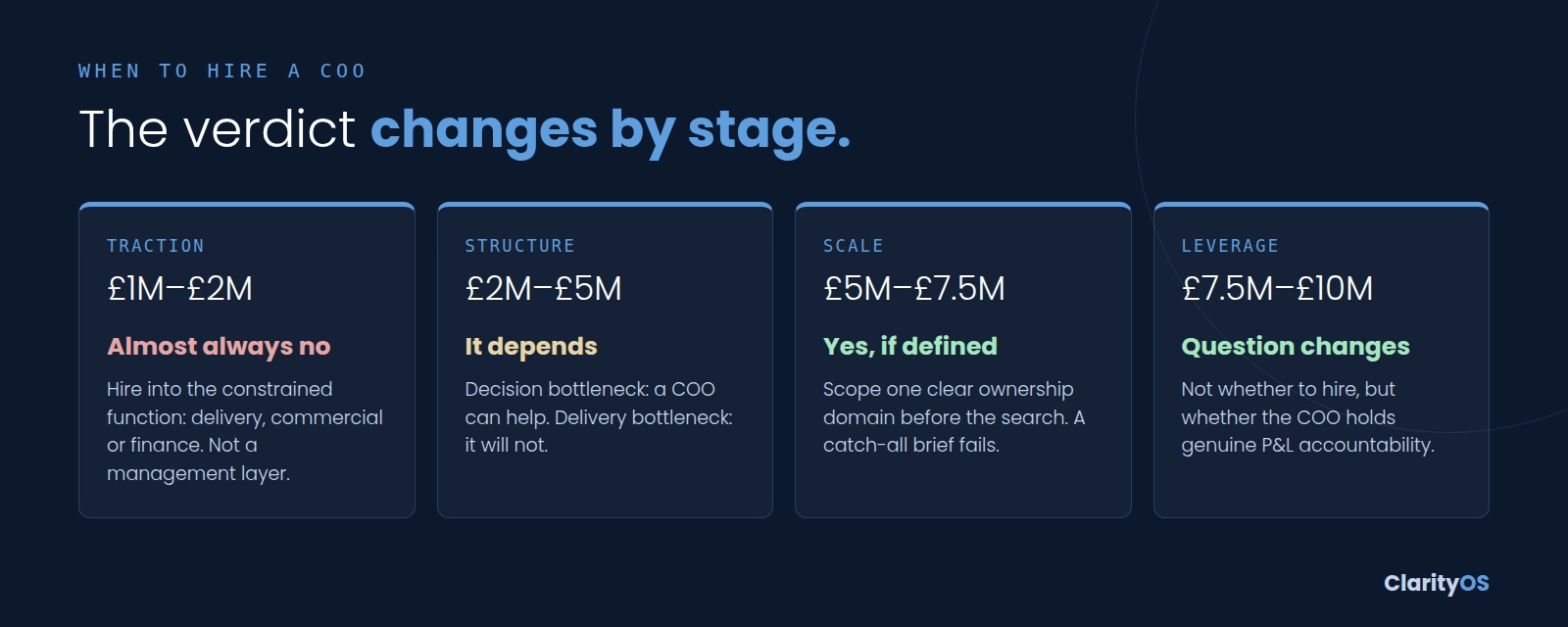
The Stage-Aligned Operating System treats £1M to £10M as four distinct stages rather than a single growth continuum: Traction (£1M to £2M), Structure (£2M to £5M), Scale (£5M to £7.5M) and Leverage (£7.5M to £10M). Each stage produces a different binding constraint, and therefore a different answer to the COO question. Research into when founders should hire operational leadership consistently shows that role definition must follow constraint diagnosis, not precede it.
The structure of this piece follows that logic directly. Getting the hire wrong at £3M looks nothing like getting it wrong at £8M: the cost, the recovery time and the underlying problem left unsolved are categorically different. Stage by stage, that distinction is worth examining carefully.
What a COO Actually Does (And Why It Changes With Revenue)
The COO title is one of the most inconsistently defined roles in business. Ask ten scaling founders what their COO does and you will get ten different answers, because the role has no fixed job description. It is defined entirely by what the CEO cannot or should not own at a given stage of growth. That definition shifts substantially as revenue grows, which means hiring logic that makes sense at £7M can be actively damaging at £2M, and vice versa.
This piece uses a specific definition throughout: a COO is a binding constraint solver, not a second-in-command. The org-chart version of the role, where someone sits one level below the CEO and broadly "runs operations," produces expensive hires that are either underutilised or set up to fail. The constraint-solver version asks a harder question first: what is the single operational bottleneck limiting growth right now, and does resolving it require a full-time C-suite hire?
The constraint changes with revenue
At around £2M, the binding constraint is almost always process and people. Delivery is inconsistent, no one owns accountability clearly, and the founder is making decisions that should be embedded in systems. At £6M, the constraint shifts to cross-functional coordination: sales, delivery and finance are no longer naturally aligned, and someone needs to hold the operating rhythm across functions. At £9M, the problem becomes organisational leverage and strategic execution capacity: the business has enough people and process to move, but not enough leadership architecture to deploy them efficiently.
A COO hired to solve a £2M process problem will have built out their brief within twelve months and either leave or expand into territory the founder did not intend to cede. A COO brought in at £8M who was excellent at early-stage process work may lack the organisational thinking the role now demands.
There is also a financial reality that constrains the decision before any of the strategic logic applies. A full-time COO at this revenue range typically costs between £90,000 and £160,000 in base salary, before employer National Insurance contributions, benefits and any equity commitment. That is a six-figure annual obligation that begins on day one, well before any operational impact is realised. At £2M revenue, that cost is not trivial. It demands precision about what problem is actually being solved.
Traction Stage (£1M to £2M): The Answer Is Almost Always No
At the Traction stage, the business has found something that works. Revenue is moving, customers are renewing or referring, and the founder is stretched. The instinct to hire a COO at this point is understandable, but it is almost always the wrong diagnosis. The binding constraint between £1M and £2M is rarely operational complexity. It is product-market fit refinement, a repeatable commercial motion that still depends on the founder to close, and the conversion of early wins into something that can be described, taught, and repeated. These are not problems a COO solves. They are problems the founder has to work through, because the founder's judgement, credibility, and relationships are, at this stage, a core part of what the customer is buying.
The structural reality is blunt: a COO manages systems, processes, and teams. At £1M to £2M, most of those structures are either embryonic or do not yet exist. Hiring a COO before the operating architecture is in place means hiring someone to manage a structure that has not been built. That person will fill their time, but they will fill it with operational administration, low-leverage tasks, and coordination work that could be handled by a strong generalist or absorbed into existing roles. A Spencer Stuart analysis of COO tenure has consistently found that misaligned mandates are a leading driver of early executive departure. At Traction stage, misalignment is almost guaranteed, because the role the founder imagines does not yet have the substance to sustain a senior operator.
The correct hire at this stage, if any hire is warranted at all, is targeted and functional. Identify the single constraint causing the most friction and hire precisely at that point. For a SaaS or technology services business at this revenue level, that is usually one of three roles: a Head of Delivery to protect margin and client outcomes, a commercial lead to extend the founder's sales capacity, or a finance manager to create visibility over cash and reporting. Each of these is a scoped intervention in a specific bottleneck. None of them requires a new management layer above the team.
Founder dependency at this stage is not the warning sign it becomes later. It is appropriate. The founder's judgement, taste, and relationships are often the product differentiation. Treating that dependency as a risk to be restructured away, rather than a resource to be protected and eventually systematised, leads to premature org chart changes that add cost and confusion without releasing the actual constraint. The goal at Traction is not to remove the founder from the business. It is to build the first layer of repeatability underneath them, so that their time concentrates on the decisions that only they can make.
Structure Stage (£2M to £5M): It Depends on the Type of Bottleneck
The Structure stage is where the COO question stops being hypothetical and starts feeling urgent. Between £2M and £5M, the founder is typically managing more complexity than the business has infrastructure to support. Decisions are queuing. The leadership team is growing but not yet autonomous. Revenue is moving, but the operating model underneath it is visibly straining. At this point, the instinct to hire a COO is not irrational. It is just frequently misdirected.
The Distinction That Changes Everything
The diagnostic question that matters most at this stage is not "do I need a COO?" It is "where exactly am I the constraint?" The answer splits cleanly into two categories, and they require entirely different responses.
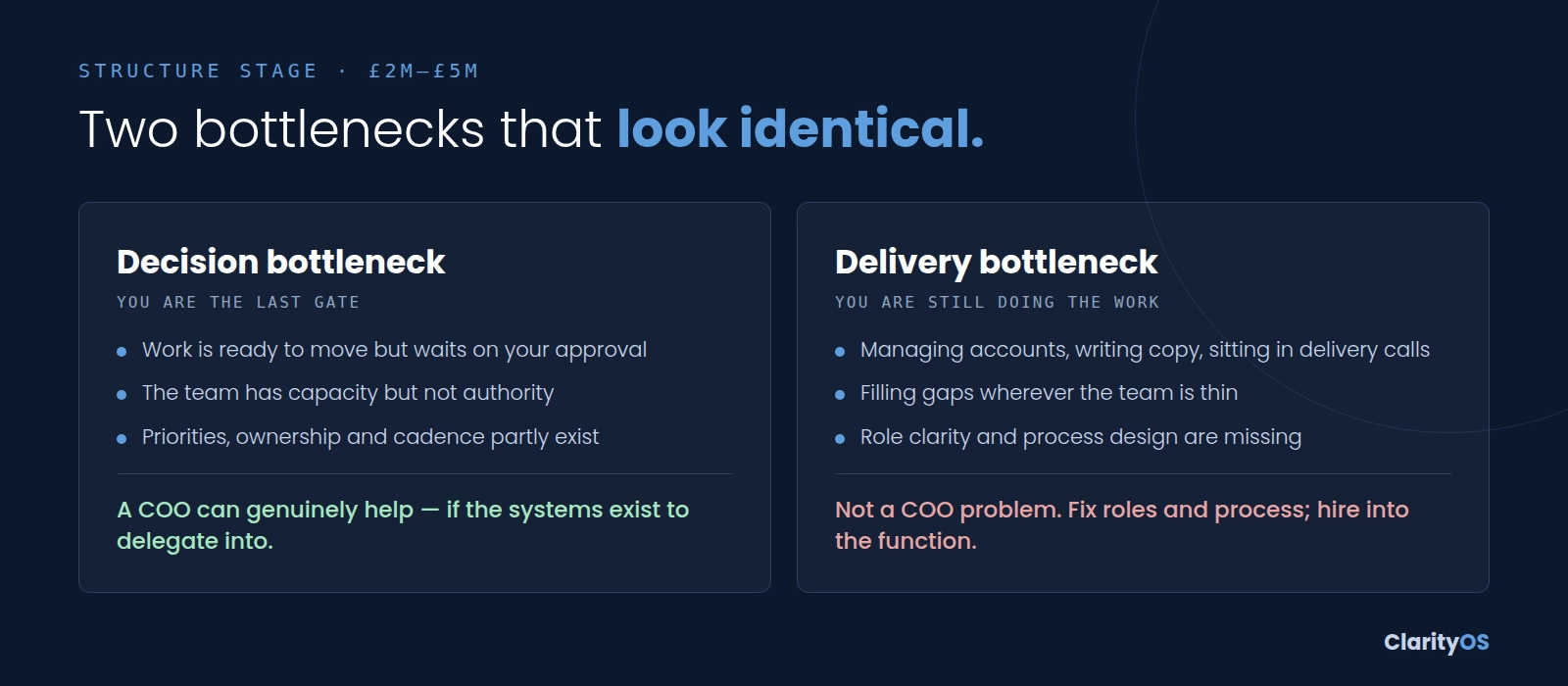
A decision bottleneck exists when the founder is the last gate on approvals, prioritisation and strategic direction. Work is ready to move but cannot move without the founder's input. The team has capacity but not authority. In this situation, a COO can genuinely help, because the role is designed to sit inside the decision architecture and carry delegated authority across functions. However, this only works if there is already a partial system in place to support that delegation. If there are no documented priorities, no clear ownership maps, and no rhythm of accountability in the business, a COO inherits the same bottleneck wearing a different title.
A delivery bottleneck exists when the founder is still doing work that should belong to others. They are managing accounts directly, writing copy, sitting in delivery calls, or filling gaps wherever the team is thin. This is not a COO problem. It is a role clarity problem, a process design problem, and in many cases a functional hiring problem at the team level. Dropping a COO into a delivery bottleneck does not remove the founder from the work. It adds a layer of management cost while the underlying dependency remains intact.
The Misdiagnosis and Its Cost
The most expensive mistake founders make at this stage is hiring a COO to resolve a founder dependency problem they have not yet correctly identified. The COO arrives, finds that decisions still route through the founder out of habit or structural necessity, and within twelve to eighteen months the relationship deteriorates. The founder concludes the hire was the wrong person. The actual constraint, which was always in the operating model and not the org chart, persists untouched.
For UK bootstrapped or lightly-funded businesses operating in this revenue band, there is also a hard financial reality to account for. A credible COO at this stage carries a base salary of £90,000 to £140,000, plus employer National Insurance contributions and any equity expectation. That is not an abstraction. For a £3M revenue business operating on realistic B2B margins, that single hire can crowd out two or three functional appointments that would have more directly addressed the bottleneck. A Head of Operations, a Finance Manager, or a senior Account Director will each have a more targeted impact than a generalist C-suite role hired before the systems exist to give it leverage.
The Structure stage is genuinely the inflection point where operational architecture starts to matter. But building that architecture is the prerequisite, not the outcome, of a successful COO hire.
Scale Stage (£5M to £7.5M): Define the Role Before You Write the Brief
By £5M revenue, the business has developed enough operational surface area that a COO hire can be meaningfully justified. There are now real functions to run, real teams to manage, and enough commercial complexity that the CEO cannot personally span the entire organisation. The question at this stage is no longer whether to hire a COO. It is whether you can define precisely what that person will own. If you cannot answer that question with specificity before you open a search, you are not ready to hire.
The Catch-All Brief and Why It Fails
The most common failure mode at the Scale stage is writing a COO brief that is essentially a collection of everything the CEO has decided they no longer want to think about. The brief reads well on paper: "responsible for operational excellence, team performance, delivery, process improvement and cross-functional alignment." In practice, it is a role with no clear centre of gravity. It attracts generalist candidates who are competent across the surface but accountable for nothing in particular. Within twelve to eighteen months, the hire has either drifted into becoming a glorified chief of staff or has quietly begun overreaching into areas the CEO still considers their own territory. The role fails, the founder attributes it to a bad hire, and the underlying operational constraint remains entirely unresolved.
The brief was the problem, not the person.
The Three Ownership Archetypes
A well-scoped COO role at the Scale stage typically owns one of three clearly bounded domains. The first is go-to-market execution: owning the commercial engine from pipeline to close, including revenue operations, sales management and customer success. The second is delivery and service operations: owning the fulfilment side of the business, including implementation, professional services, client outcomes and the operational metrics that underpin them. The third is internal systems and people: owning the infrastructure that makes the business function, including hiring, HR, finance operations and tooling.
These three archetypes are genuinely distinct in terms of the profile they require, the decisions they involve and the stage at which each becomes the binding constraint. The error is hiring a COO to own all three simultaneously. That is not a COO remit; it is a co-CEO structure without the title, and it creates authority conflict at the executive level almost immediately.
The Two Questions That Define Readiness
Before the brief is written, two questions need clear written answers. What specific outcomes will this COO own, measured how? And which decisions can they make without the CEO's involvement? If either answer contains the phrase "we'll figure that out as we go," the role definition is incomplete.
In UK SaaS and tech services businesses at this revenue band, it is also worth noting that the COO function is sometimes better expressed as two distinct hires: a VP of Engineering and a Head of Operations, rather than a single consolidated executive. This is not a compromise; in many cases it is the structurally correct answer, particularly where the technical and commercial delivery constraints are operating independently and require different kinds of leadership. Both routes are legitimate. The choice should follow the constraint, not the org chart convention.
Leverage Stage (£7.5M to £10M): The Question Changes Entirely
By the time a business reaches £7.5M in revenue, the COO question has already been asked and answered. The real conversation at this stage is not whether a COO belongs on the leadership team. It is what that COO genuinely owns, and whether the CEO-COO relationship is structured to produce real accountability rather than a polished org chart with no weight behind it.
The binding constraint at Leverage stage is organisational in nature. The CEO must be operating at board level and market level: managing investor relationships, driving strategic partnerships, and building the commercial narrative that positions the business for its next phase. That is a full-time job. It cannot coexist with being the de facto head of operations, the final word on every significant delivery decision, and the person every function defaults to when coordination breaks down. Something has to give. At this stage, what gives is the internal operating model, and it gives to the COO.
What that transfer requires, concretely, is P&L accountability. Not coordination. Not a structured seat in the weekly leadership meeting. The COO at Leverage stage must own operating performance against plan, hold budget commitments across functions, and be the person who stands behind the numbers when the board or investors review them. According to Investopedia's breakdown of the COO role, the function is defined by translating strategy into execution across the full business, but at this revenue level that definition needs to extend further: the COO must be the named accountable owner of that execution, not a senior coordinator who escalates upward when things get difficult.
The failure mode worth naming directly is the COO who is present in the structure but subordinate in every real decision. This arrangement is common, and it is costly. The CEO continues to be pulled into operational matters because the COO does not hold genuine authority. The hire adds headcount and salary but does not release the CEO from the operating burden it was designed to remove. The business has the title without the structure that gives it meaning.
This is also the stage at which investor and exit readiness enters the frame as a live consideration. A COO with documented ownership of operating performance tells a specific and credible story to acquirers and institutional investors: the business runs without the founder at the centre of daily execution. That is not a soft signal. It is evidence of institutional capacity, and it materially strengthens the commercial narrative for a raise or a sale. A business approaching £10M where all operating performance is visibly founder-dependent carries a structural risk discount that a well-positioned COO appointment removes.
The question at this stage, then, is not whether to hire. It is whether you are prepared to build a CEO-COO relationship with genuine division of authority, or whether you are about to make a well-intentioned hire that leaves you in exactly the same position, only with a larger wage bill.
The Failure Pattern Nobody Talks About
There is a pattern in COO hiring that almost nobody discusses openly, because the people who live through it rarely frame it correctly afterwards. A founder becomes overwhelmed by operational complexity, concludes they need a COO, recruits one, and then watches the hire struggle. Delivery does not improve at the pace expected. Decisions still stall. The founder begins to doubt the person in the seat. Within 12 to 18 months, the relationship breaks down and the business begins a leadership transition. The founder concludes they hired the wrong person. The underlying constraint remains entirely unresolved.
The misdiagnosis here is almost universal. The failure is not about the quality of the COO candidate. It is about the absence of the operating infrastructure that any COO, regardless of their experience, needs in order to function. Clear decision rights. Documented processes. Defined functional ownership. Reporting lines with teeth. When none of those exist, a COO does not walk into a role; they walk into a vacuum. They spend the first six months building the foundations that should have existed before they were hired, doing so without the positional authority or organisational context to do it well, and the founder interprets the slow start as underperformance.
The cost of this in a UK business context is substantial. A COO-level hire at the £2M to £5M stage typically carries a six-figure base salary, often between £90,000 and £140,000 depending on sector and location, plus employer National Insurance contributions, benefits and any equity component. Across 12 to 18 months before a decision is made to part ways, the direct cost is considerable. Add the disruption of a leadership change, the confusion it creates in the team around reporting and accountability, and the recovery period that follows, typically six to twelve months before the business is operating with any renewed clarity, and the total cost of the failed hire extends well beyond the salary line.
What makes this pattern particularly damaging is what it does to the founder's mental model of the COO role itself. Founders who have lived through this experience frequently conclude that COOs do not work, or that the role is ill-defined, or that they simply need to keep doing it themselves. That conclusion is the second failure. The correct lesson is that they solved the wrong problem at the wrong time. The business needed operating systems. It received an executive instead.
The question that would have prevented the hire, or at least forced the right preparation before making it, is direct: what specifically will this person own on day one, and what systems exist today to support that ownership? Both parts of the question matter equally. If the answer to what they will own is expressed in vague terms such as "operations" or "running the business," the role has not been defined. If the systems that would support their ownership, process documentation, functional handoffs, reporting infrastructure, do not yet exist, the business is not ready for the hire. Vagueness in either answer is not a reason to delay and reconsider. It is a signal that the real work is structural, not organisational.
The Fractional COO and Operating Partner Alternative
The fractional COO model is a legitimate option, and it deserves an honest assessment rather than either uncritical enthusiasm or reflexive dismissal. For a business in the Structure stage, sitting somewhere between £2M and £5M revenue, that has a genuine decision-bottleneck problem but cannot yet absorb a full-time executive salary, a fractional arrangement can provide COO-level thinking and decision-making capacity on a contained scope. The use case is specific: a defined piece of operational territory, a defined period of engagement, and a clear outcome the arrangement is working toward. What it is not is a permanent solution, and any founder or adviser who positions it as one is setting the business up for a gap when the engagement ends.
The risk that tends to go undiscussed in the UK market is organisational authority. A fractional COO, however capable, occupies a structurally ambiguous position inside a business. They are present for a fraction of the working week, they are not embedded in the culture on a daily basis, and their ability to drive the kind of structural and cultural change that a Structure-stage business genuinely needs is constrained by that absence. The team can respect them without quite following them. The founder may lean on them without quite trusting them with the decisions that matter most. This is not a character problem; it is a structural one. The authority required to rewire how a business operates tends to belong to people who are fully in it.
This is where founders frequently conflate two different problems, and make the wrong call as a result. An Operating Partner or structured advisory engagement addresses a different constraint entirely. It is not a substitute for a COO, and it should never be positioned as one. It is the appropriate response when the binding constraint is not execution capacity but founder dependency and operating model design. If the business is slowing because the founder is the decision bottleneck, because they are holding context that has not been transferred, because the operating model underneath them has not caught up with the revenue, then adding a fractional or full-time COO does not solve that. It adds a layer on top of a problem that is still unsolved.
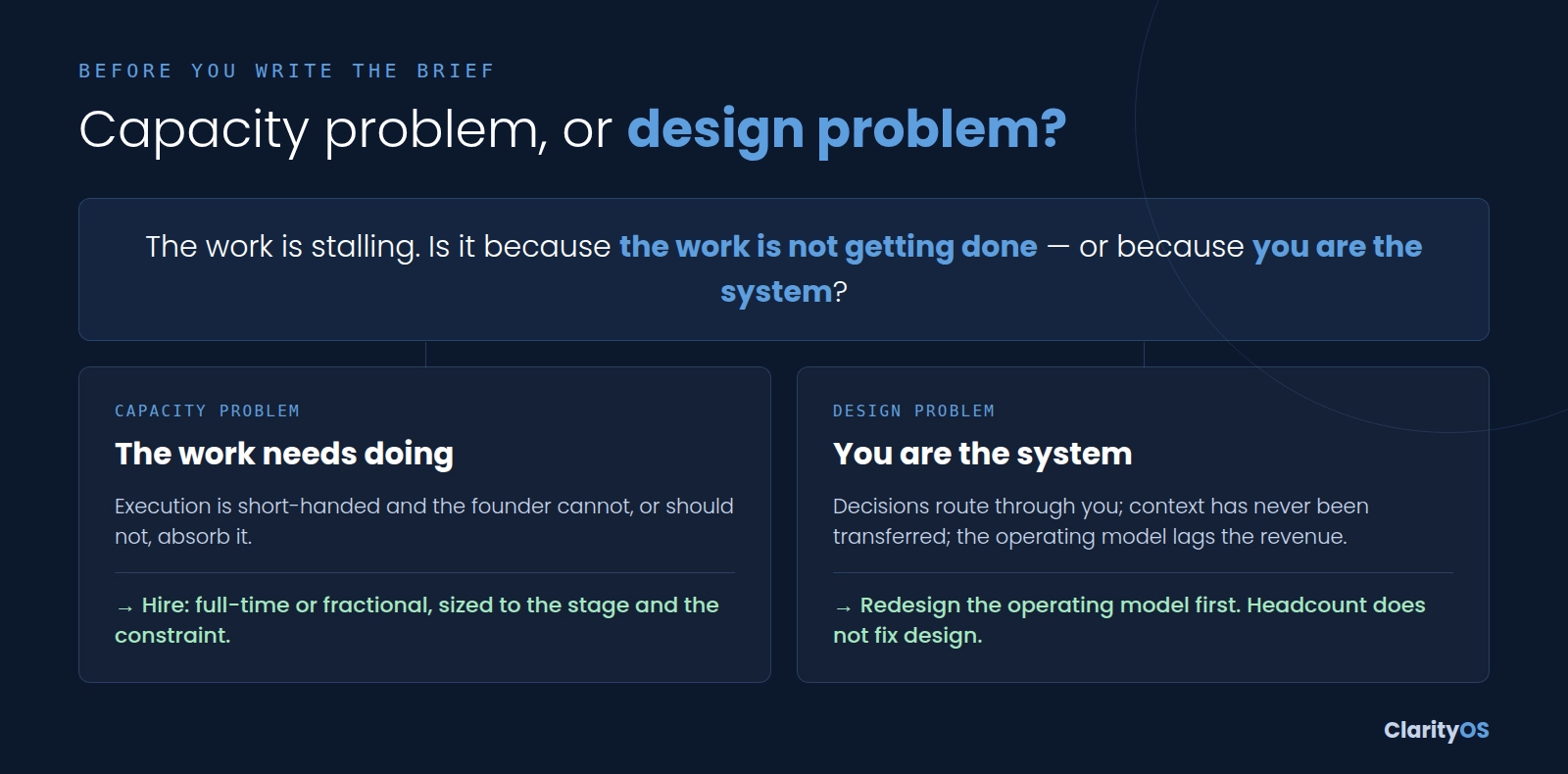
The honest decision framework is straightforward, even if applying it requires some directness about what is actually broken. If the work needs doing operationally and the founder cannot or should not be doing it, hire someone, whether full-time or fractional depending on stage and cost tolerance. If the problem is how the founder is operating, what they are holding, and how the business is structured around them, then a structured advisory or coaching engagement is the more appropriate lever. Headcount does not fix operating model problems. It can obscure them temporarily, which is arguably worse, because the underlying constraint remains and the cost base has increased.
The question to ask is a simple one: is this a capacity problem or a design problem? If you cannot answer it clearly, that ambiguity is itself diagnostic information, and it points toward the latter.
A Practical Test You Can Apply This Week
The following five questions take fewer than twenty minutes to work through. Do them on paper, not in your head. Vague answers are data too.
Question 1: Which revenue stage are you in?
Place yourself in one of four bands: Traction (£1M to £2M), Structure (£2M to £5M), Scale (£5M to £7.5M), or Leverage (£7.5M to £10M). If you are in the Traction stage, stop here. The business does not yet have the operational surface area, the management layer, or the process infrastructure to absorb a COO hire productively. The constraint is almost never a missing executive; it is a missing system or a missing senior operator in one specific function. Return to this test when revenue crosses £2M.
Question 2: What three decisions slowed down most in the last 90 days?
Write them down specifically. Not categories like "sales" or "hiring," but the actual decisions that sat on your desk longer than they should have. Now ask one question about each: did it stall because you did not have time to make it, or because the information, process, or delegation infrastructure did not exist to let anyone else make it? The first is a capacity problem. The second is a systems problem. A COO cannot solve a systems problem that has not yet been diagnosed, because they will arrive into the same fog you are currently navigating.
Question 3: What would a COO's week one look like?
If a COO started next Monday, describe their first five days in concrete terms. Which meetings would they attend? Which decisions would they be making by day thirty? Which function would they own within ninety days? If you cannot answer this with specifics, the role is not defined. Hiring an executive into an undefined role is one of the most reliable ways to guarantee an expensive failure within eighteen months. The brief comes before the hire, not after.
Question 4: Is the work not getting done, or are you doing work you should not own?
These two problems look identical from the outside but require completely different responses. A delivery bottleneck means the business lacks execution capacity; a seniority hire may eventually be the right lever, though often a head of function is sufficient. Founder dependency means you are the system, and adding a COO above an undelegated operating model will not resolve that; it will add cost and a layer of confusion.
Question 5: What would you stop doing, and is it documented?
List the five things you would hand over on day one. Now ask whether each of those things is documented well enough for someone else to own it without your ongoing involvement. If more than two of the five answers are no, the immediate priority is documentation and operating rhythm, not a hire. You cannot delegate an undocumented process to a senior executive and expect it to hold.
Scoring your answers
If questions 2 through 5 produced specific, concrete answers, you likely have sufficient role clarity to begin writing a COO brief. If two or more answers were vague or dependent on things that do not yet exist in written form, the binding constraint is founder dependency. That is a different problem, and it requires a different response. A premature COO hire will not solve it. A structured diagnostic almost certainly will.
The Right Decision Starts With the Right Diagnosis
The COO question was never really about the COO. It was a signal that something in the operating model has stopped working, and the founder has reached for the most visible lever available. Whether that lever is the right one depends entirely on where the business sits and what type of constraint is actually binding.
The stage verdicts in this piece are deliberate. At Traction, the answer is almost always no; the business needs a senior operator in the constrained function, not a layer of coordination overhead. At Structure, the answer depends on whether the founder is the bottleneck in decisions or in delivery, and those require different responses. At Scale, the right move is to define the role with precision before opening a search. At Leverage, the question has already shifted; the conversation is about ownership and accountability within a complex structure, not about whether a COO belongs at the table.
If the practical test in this piece returned vague or uncomfortable answers, that is useful information. Vagueness at this stage usually means the constraint has not been diagnosed clearly enough to build a role around. Launching a hiring process before that diagnosis is complete produces briefs that are too broad to recruit against and too imprecise to retain a strong operator once hired.
The ClarityOS Diagnostic is built for exactly this juncture. It maps founder dependency, commercial maturity and stage alignment, and returns a 90-day plan that tells you what the binding constraint actually is. It is a tool for clarity, not a preamble to a sales conversation.
The most expensive COO hire is the one made before the founder understands what they need. When the role is misaligned from the start, the hire fails, the founder attributes the failure to the person rather than the brief, and the underlying constraint remains entirely unresolved. A structured diagnosis costs a fraction of that outcome, and it leaves you with something a COO search cannot give you on its own: a precise understanding of what you are actually trying to solve.